Skill Integration
Skills are a natural OAN resource type because they are useful, reusable, and often updated. A skill may live in a Git repository, package registry, marketplace, local bundle, or assistant-specific format. OAN does not need to host every skill file. It needs to publish a verifiable resource envelope around the skill.
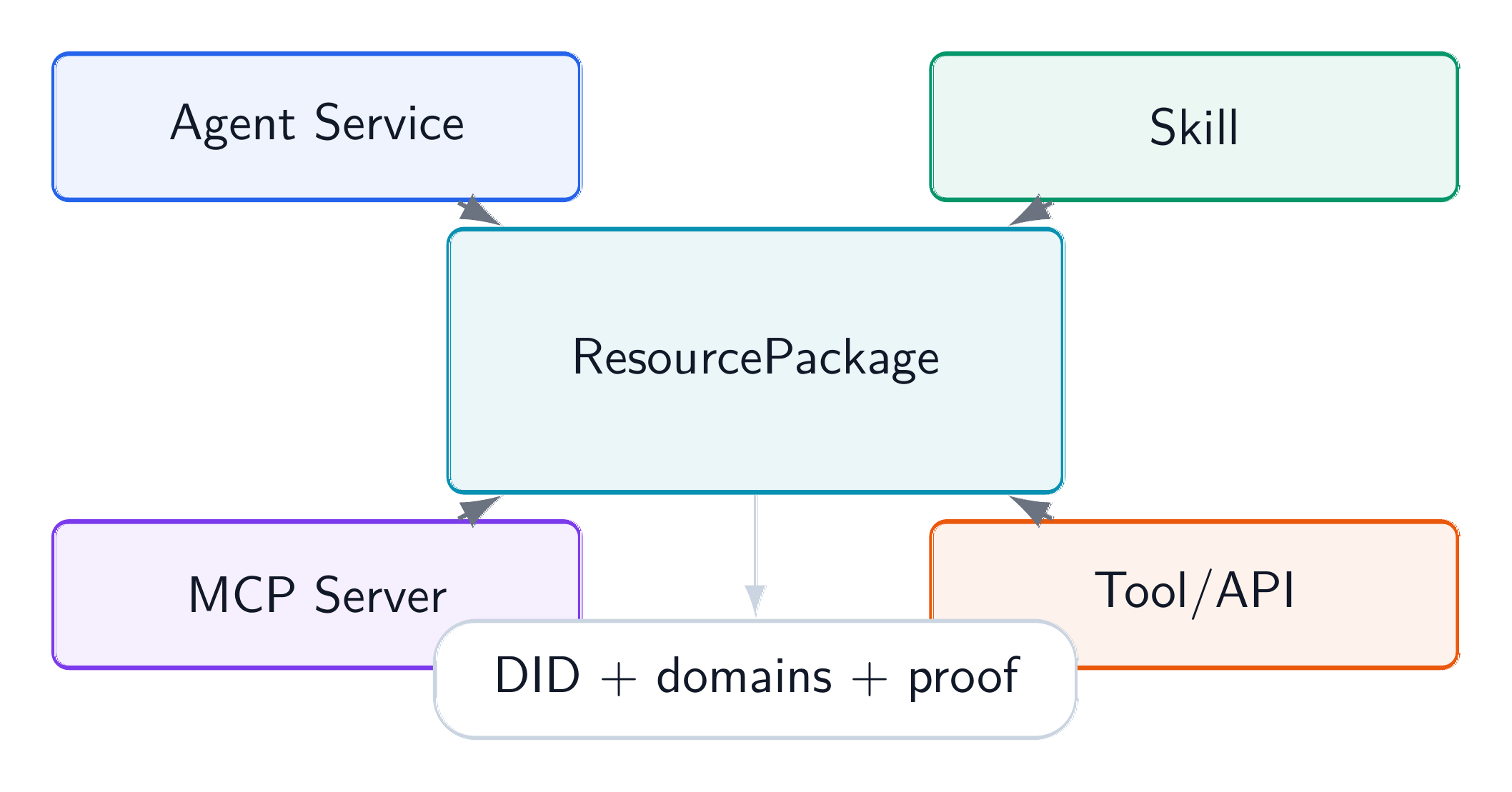
That envelope gives the skill a stable DID, metadata, authorized domains, capability tags, version, package references, hashes, lifecycle, and Root proof.
This is particularly useful because skills often spread through informal channels: repositories, local folders, assistant marketplaces, shared archives, or community examples. OAN does not need to centralize all distribution. It gives consumers a way to verify which skill package or manifest was published under which identity and version.
What To Register
A Skill resource should include:
- skill name and description;
resourceTypeindicating a skill;did:oanidentity;- manifest URL, repository URL, artifact URL, or package reference;
- version string;
authorizedDomains;capabilityTags;- examples or task descriptions;
- package, manifest, or artifact hashes where applicable;
- metadata hash and package hash;
- lifecycle expectations.
The most useful registrations are specific. “Helpful AI skill” is not enough. “Summarizes engineering design documents and extracts architecture risks” is much better.
Include enough information for both humans and semantic Discovery. A good skill description tells the user what task the skill helps with, what inputs it expects, and what output or workflow it produces. Capability tags should reinforce that description rather than repeat the title.
Fast-Moving Versions
Skills can change often. That is not a problem if versioning and package evidence are handled correctly. The resource DID can remain stable while each accepted package version records updated facts. Discovery can then surface the latest active version while preserving auditability for previous versions.
For skill publishers, this means you should not treat OAN registration as a one-time static listing. When a skill changes meaningfully, prepare updated package facts and publish a new version. When a skill is no longer suitable for use, lifecycle state should reflect that.
Fast updates are not a reason to weaken verification. They are a reason to make versioning routine. A consumer should be able to tell whether they are installing the current active version, a pinned historical version, or a superseded version kept only for reproducibility.
Discovery and Installation
Discovery can help a user find a skill by task, tag, domain, or description. After a candidate is selected, the client should verify OAN evidence before installation or loading. Then the native skill mechanism takes over: package fetch, manifest parsing, permission review, sandboxing, and assistant-specific installation behavior.
This separation lets OAN support multiple skill ecosystems. It does not require every skill format to become the same. It only requires the public resource envelope to be verifiable.
For assistant platforms, this means OAN can become a discovery and trust layer above their existing skill installation mechanisms. The platform can keep its own sandbox, permission, and UI rules while using OAN to verify identity and package evidence before installation.
Community Skill Loop
There is a nice recursive adoption pattern here: the OAN community skill can help users publish and discover other skills through OAN. That is useful as long as boundaries remain clear. The community skill can guide metadata preparation, call official or configured endpoints, and explain lifecycle. It should not silently bypass verification or perform private official operations.
This gives non-expert users a practical path: describe the skill, choose domains and tags, register it, wait for lifecycle progression, then query Discovery to confirm it can be found.
It also gives skill maintainers a repeatable release habit. The community skill can help prepare a new version, compute or collect package facts, submit registration, and then confirm Discovery visibility. That workflow is much easier to repeat than remembering a long manual checklist.
Quality Guidelines
Good skill metadata should include:
- what the skill does;
- what inputs it expects;
- what outputs it produces;
- what environment or assistant it targets;
- what permissions or external access it may need;
- what domains it belongs to;
- what tags help users find it;
- where the manifest or package can be verified.
Skill registries can become noisy quickly. OAN’s evidence model helps trust, but metadata quality still determines whether Discovery feels useful.
For public skills, include limitations as well as capabilities. If a skill assumes a specific assistant environment, requires local files, contacts external services, or is experimental, say so. Honest metadata improves user trust and reduces failed installations.