Tool/API Integration
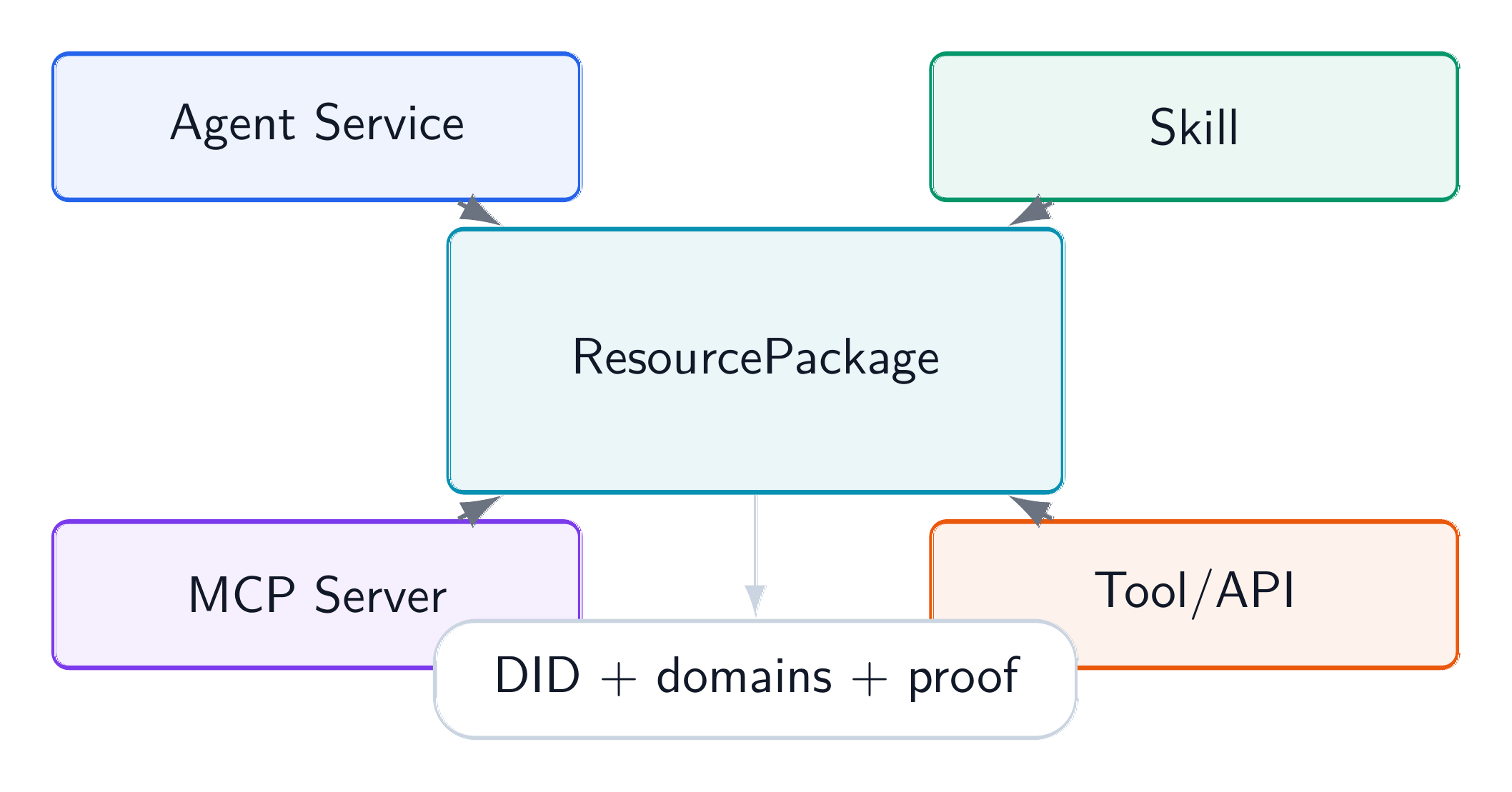
Tool and API resources let OAN describe callable capabilities that are not necessarily full agent services or MCP servers. They may be REST APIs, RPC endpoints, schema-described tools, SaaS operations, or domain-specific service calls. OAN gives them identity, discoverability, and pre-use evidence.
OAN does not replace API authentication, authorization, rate limits, billing, input validation, or business policy. It helps a client decide whether the API resource itself came from a verified publication path.
This makes Tool/API integration a good entry point for existing SaaS and enterprise systems. A provider can keep its API design, authentication scheme, billing model, and gateway. OAN adds a discoverable identity and verifiable metadata wrapper around the API resource.
What To Register
A Tool/API resource should include:
- resource name and description;
resourceTypeindicating Tool/API;did:oanidentity and DID Document;- endpoint URL or endpoint template;
- schema reference, such as OpenAPI or another machine-readable contract when available;
- protocol and method expectations;
- authentication notes or policy references if public;
authorizedDomains;capabilityTags;- version and package metadata;
- hashes for schema, metadata, or package material.
If the API is private, do not publish secrets. OAN metadata should describe how the resource is discovered and verified, not leak credentials.
For private or partner APIs, publish enough to identify and verify the resource, then let the native access process handle credentials. A registration can say that authentication is required, point to public policy documentation, or name the expected protocol without exposing tokens, client secrets, or internal network details.
Schema Binding
Schema references are valuable because they let clients understand what they may call. If an OpenAPI document or another schema is part of the accepted package facts, its hash should be bound to the package. That prevents a client from verifying one resource description and then calling an endpoint whose schema changed silently.
For dynamic APIs, publish stable schema versions and update the ResourcePackage when the public contract changes. Avoid treating mutable documentation pages as proof unless their content is hash-bound or versioned.
Schema binding is also valuable for agent safety. An agent that plans an API call should know which operation surface it is planning against. If the schema changes after Discovery, the client should detect that through version and hash checks rather than silently calling a different contract.
Before Calling the API
A client should:
- discover candidate Tool/API resources;
- verify Discovery response evidence;
- verify Root proof and package hashes;
- check lifecycle and domains;
- confirm endpoint and schema binding;
- apply native API authentication and authorization;
- enforce local policy before making calls.
This protects both sides. The resource provider gets a verifiable discovery path. The consumer keeps control over runtime access.
The same pattern can be embedded in API gateways. A gateway can verify OAN evidence before allowing a resource into a tool catalog, then enforce ordinary gateway policies at call time. That is often a more realistic enterprise integration than asking every application team to perform every check manually.
Examples of Useful API Resources
Tool/API resources might include document conversion APIs, code analysis endpoints, enterprise search APIs, risk scoring tools, data transformation services, compliance checkers, scheduling tools, or domain-specific calculators. They do not need to behave like autonomous agents. They only need to be valuable callable resources that agents or users may want to discover.
The more precise the metadata, the better Discovery can work. A resource described as “API service” is weak. A resource described as “OpenAPI-compatible endpoint for detecting security risks in REST API specifications” is much more discoverable.
Examples are especially helpful for semantic Discovery. A short example such as “input: OpenAPI document; output: endpoint risk report with severity labels” gives the retrieval engine and human reader a clearer view than a list of generic tags.
Trust Boundary
OAN can tell you that a Tool/API resource was published and discovered through a governed path. It cannot tell you that every call is safe for your data, budget, compliance posture, or user intent. Keep ordinary API controls in place.
This boundary is not a weakness. It is how OAN stays compatible with many API styles and enterprise policies.
When integrating Tool/API resources, decide what should be trusted globally and what should remain local policy. OAN can globally verify identity and package evidence. Whether a specific user may call a paid endpoint with sensitive data should remain under the consumer’s own authorization and governance.