For Enterprises
Enterprises do not need to begin by publishing public resources. They can begin by consuming OAN evidence. A procurement process, API gateway, AI governance program, or internal agent platform can use OAN data to decide whether a resource has identity, Root proof, lifecycle state, domain scope, and package integrity.
OAN should complement enterprise controls, not replace them. Identity and proof are inputs to policy. They do not remove IAM, API authorization, data controls, audit, legal review, or risk management.
That complementarity is what makes OAN practical for enterprises. Most organizations already have security gateways, approval flows, vendor review, logging, and data policy. OAN can feed those systems with better resource evidence instead of asking the enterprise to abandon its controls.
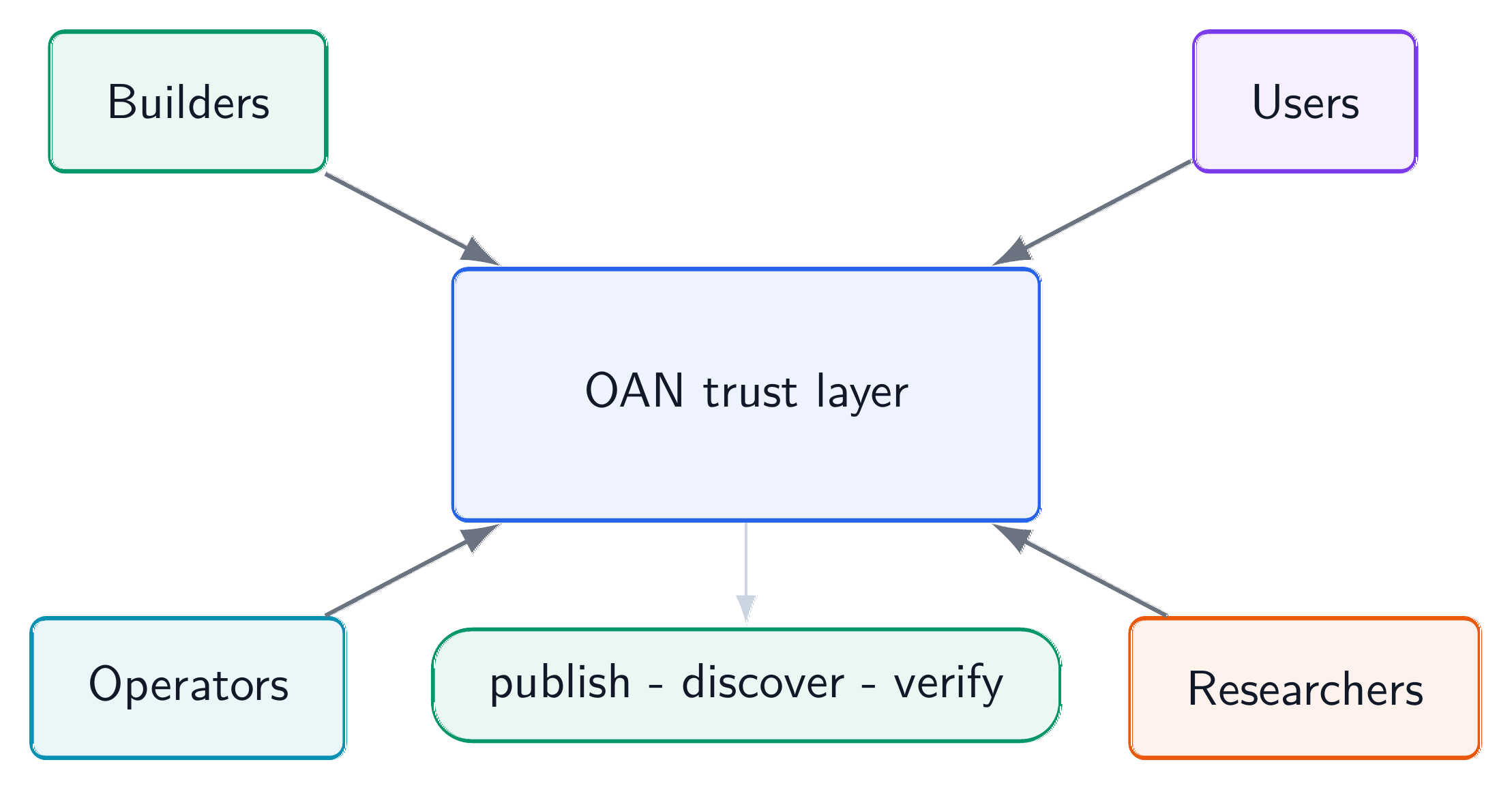
Evidence Enterprises Can Use
Useful evidence includes:
- resource DID and DID Document;
- resource type;
- controller or publisher information where available;
- authorized domains;
- capability tags and descriptions;
- Root proof;
- DID Document, metadata, package, and artifact hashes;
- lifecycle state;
- Discovery response provenance;
- endpoint or artifact binding;
- node authorization and status for infrastructure endpoints.
This evidence can be consumed manually at first and later integrated into tooling.
The first integration does not need to be complex. An internal reviewer can record the resource DID, package version, Root proof, endpoint binding, and lifecycle state in an approval ticket. Later, the same fields can be checked automatically by a gateway or agent platform.
Where It Fits
OAN evidence can fit into:
| Enterprise control | How OAN helps |
|---|---|
| AI tool approval | Shows resource identity, type, package proof, and lifecycle. |
| API gateway policy | Provides endpoint binding and resource metadata before allowing calls. |
| Procurement review | Adds verifiable publication facts to vendor or tool review. |
| Internal agent platform | Lets agents select from verified candidates rather than arbitrary endpoints. |
| Audit | Preserves evidence about what was discovered and what was verified. |
The enterprise still decides which resources are allowed for its users and data.
This is important for compliance teams. OAN can improve provenance and Discovery trust, but it does not decide whether confidential documents may be sent to a given service, whether an API call is allowed under a contract, or whether a tool meets an internal model-risk policy.
Controlled Publication
Enterprises may later publish their own resources. A company could register an internal or public API, an MCP Server, or a Skill. Depending on deployment, the resource might be public, private, or exposed through a controlled Discovery node. The same modeling principles apply: DID identity, domains, tags, package evidence, lifecycle, and verification.
Large organizations may eventually operate specialized Registrars or Discovery nodes for controlled domains. That path requires governance and operational readiness; it should not be confused with simply deploying a website.
An enterprise-private deployment may use OAN concepts internally before participating in a public trust domain. That can be useful for controlled pilots. The enterprise can learn the resource model, verification flow, and policy integration while deciding later whether any resources or nodes should become public.
Risk Boundaries
OAN does not certify that a resource is safe for every enterprise. It provides a trust envelope. Enterprises still need policies for data sharing, user approval, prompt injection, tool permissions, authentication, rate limits, legal obligations, and incident response.
The value is that these controls can start from a verifiable resource identity rather than an unstructured link.
This reduces a common enterprise AI risk: tools entering workflows as copied URLs, package names, or informal instructions. OAN gives those tools a structured identity and evidence record that can be reviewed and logged.
First Enterprise Experiment
A practical first experiment is to take one agent workflow that uses external tools and replace ad hoc tool selection with OAN Discovery plus verification. Record the DID, package evidence, lifecycle, and native endpoint used. Then evaluate how that evidence could flow into approval, logging, or policy.
A second experiment is to register one internal resource, such as an API or MCP Server, and require internal clients to verify it before use. That tests the publisher side and the consumer side without requiring broad public exposure.